


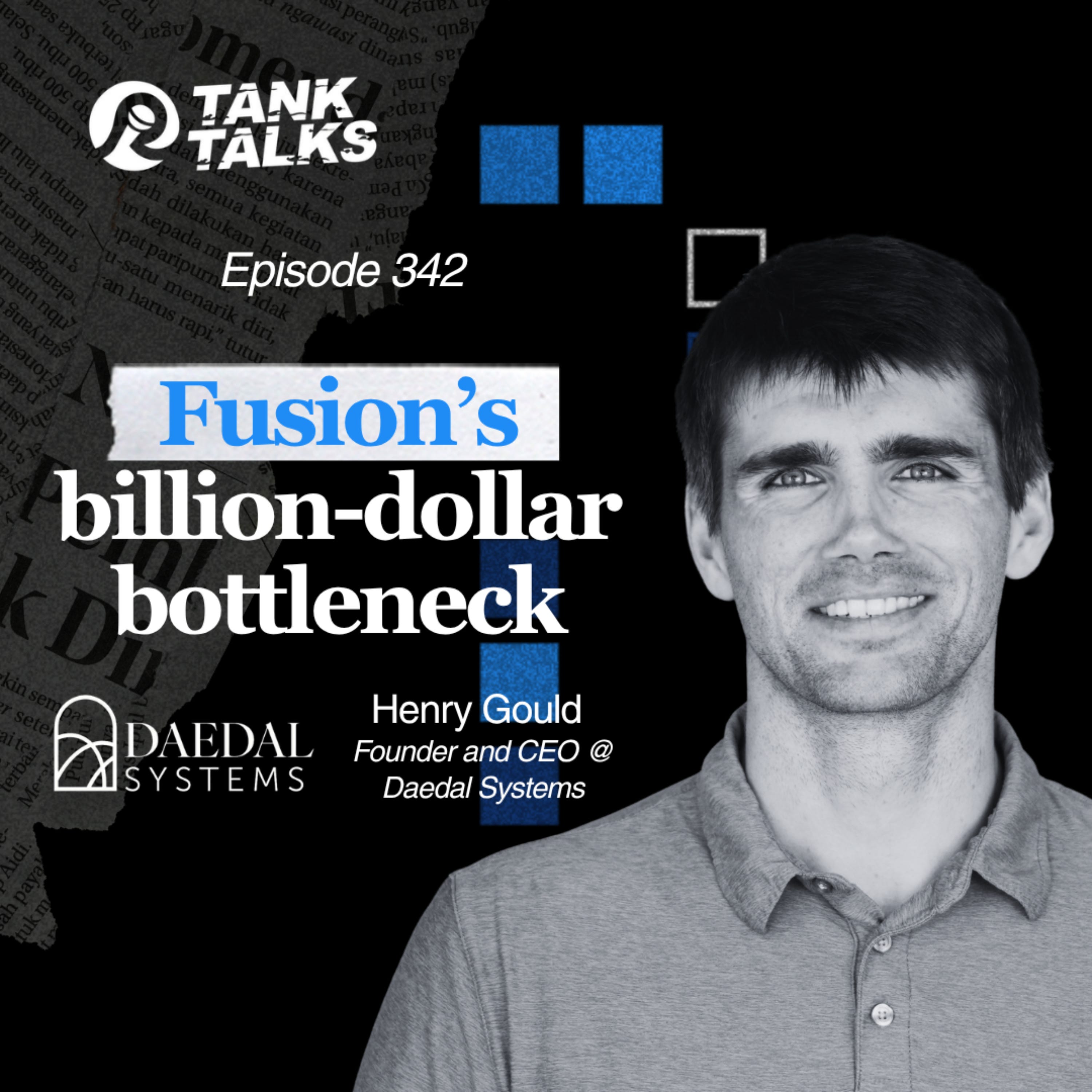
In this episode of Tank Talks, host Matt Cohen sits down with Henry Gould, founder of Daedal Systems, to explore his journey from a childhood fascination with physics to building the measurement infrastructure for the entire fusion energy industry. Henry shares his path from Queen’s Engineering Physics to the plasma diagnostics team at General Fusion, where he worked on the PI3 project and saw a structural problem: every fusion company was building the same diagnostics in-house, underinvesting in them because they weren’t core IP.
They break down why fusion is fundamentally different from fission, the “triple product” that defines every reactor’s performance, and the 2022 breakthrough at the National Ignition Facility that served as the industry’s Wright Brothers moment. Henry explains why the biggest bottleneck to commercialization isn’t the physics, but the lack of standardized, trusted measurement systems to validate milestones for investors. He opens up about the “apparent conflict of interest” of being paid by customers while serving as an industry validator, why tritium is worth $30,000 per gram, and why Ontario’s CANDU reactors give Canada a strategic advantage in the global fusion race.
Whether you’re deep in the fusion space, investing in frontier tech, or just curious about the Holy Grail of energy, this conversation offers a rare look inside the supply chain that will make or break the fusion industry.
The Holy Grail of Energy: Why Fusion Is So Hard (02:35)
Why fusion is called the Holy Grail: abundant fuel from seawater and lithium, no long-lived radioactive waste, dispatchable power
The challenge: overcoming electrostatic repulsion to fuse positively charged nuclei at 100 million degrees Celsius
The two main approaches: magnetic confinement and laser inertial fusion, and the 2022 scientific breakeven milestone
The caveat: scientific breakeven only measures energy out of the plasma, not the total energy input to power the lasers
Inside General Fusion: Plasma Diagnostics and the PI3 Project (04:52)
Joining General Fusion as an intern, then full-time on the plasma diagnostics team
The “first wall problem” and how General Fusion’s liquid metal wall approach solves it
What PI3 (Plasma Injector 3) is and why it’s essential to the reactor architecture
The challenge of measuring a superheated gas at 10 million degrees: you can’t just stick a thermometer in
The triple product: density, temperature, and confinement time as the universal benchmark for fusion performance
Why Now? The Forces Converging on Fusion (10:02)
AI power demand making abundant energy essential
Geopolitical risk and the push for sovereign energy infrastructure
40% year-over-year growth in fusion investment and 10% growth in the number of companies
Why investors are waking up to both the science risk and the massive payoffs
The Founding of Daedal Systems: Standardizing the Missing Layer (13:00)
Seeing the structural problem: every fusion company needs the same diagnostics, but builds them in-house
Why diagnostics are underinvested relative to core IP
The vision: a platform of standardized diagnostic hardware and a generalized data analysis layer
Being architecture-agnostic: serving tokamaks, stellarators, mirror machines, and inertial approaches
Measurement as a Service: Validation, Trust, and the Investor Milestone Path (17:05)
The fourfold value proposition: higher quality measurements, faster, focused on core IP, and validation
The codified development path
Why peer-reviewed papers take 18 months, and arXiv posts lack validation
The “apparent conflict of interest” of being paid by customers while serving as an industry validator
Why trust is the entire business: “Any distrustful act is going to kill the company for the long term”
Ontario’s Strategic Advantage: Tritium, Talent, and the CANDU Legacy (20:28)
Why Henry moved back from Vancouver to build Daedal Systems in Toronto
The CANDU heavy water reactors and their byproduct: tritium, essential fuel for fusion
Tritium economics: $30,000 per gram, and 55 kilograms needed to start a reactor ($1.5–2 billion)
Canada’s vast majority of the world’s civilian tritium supply
The Center for Fusion Energy in Ontario and Daedal as the first private company on board
Competing with Incumbents: Why Private Industry Needs Something Different (23:08)
General Atomics as the leader in plasma diagnostics for large public devices like ITER
Why private fusion companies need a measurement partner with a business model that works for them
The motivation for talent: working on infrastructure that benefits the entire industry, not just one device
Beyond R&D: Adjacent Markets and the Long-Term Vision (26:38)
Starting with R&D-phase diagnostics for comprehensive understanding
Expanding to SMRs for neutron detection and other plasma industrial processes like semiconductors
The long-term vision: operating infrastructure for the fusion power industry
Why Daedal provides value today, not waiting for a mature fusion industry
SMRs vs. Fusion: Clearing Up the Confusion (27:31)
SMRs as advanced nuclear fission: smaller, mass-manufacturable, competitive levelized cost of energy
Henry’s hot take: “I’ll wait to see what the energy price is”
The waste problem: long-lived radioactive waste vs. fusion’s much shorter-lived byproducts
Why fusion isn’t waste-free: tritium has a 12-year half-life, and neutron bombardment activates steel, but it’s fundamentally different from fission
The Road Ahead: Becoming the Standard for Every Fusion Device (29:38)
The plan: become the measurement system provider for every next fusion device built
Accelerating the build-test-learn loop and commercialization
Building in downtown Toronto, at the heart of Canada’s nuclear ecosystem
About Henry Gould
Henry Gould is the founder of Daedal Systems, a company building the measurement infrastructure for the fusion energy industry. Previously, he worked at General Fusion on the plasma diagnostics team, serving as an engineer, physics lead, and technical project manager on the PI3 project. He holds a degree in Engineering Physics from Queen’s University and grew up in Toronto.
Connect with Henry Gould: https://www.linkedin.com/in/whenrygould/
Visit the Daedal Systems website: https://daedalsystems.com/
Connect with Matt Cohen on LinkedIn: https://ca.linkedin.com/in/matt-cohen1
Visit the Ripple Ventures website: https://www.rippleventures.com/


