


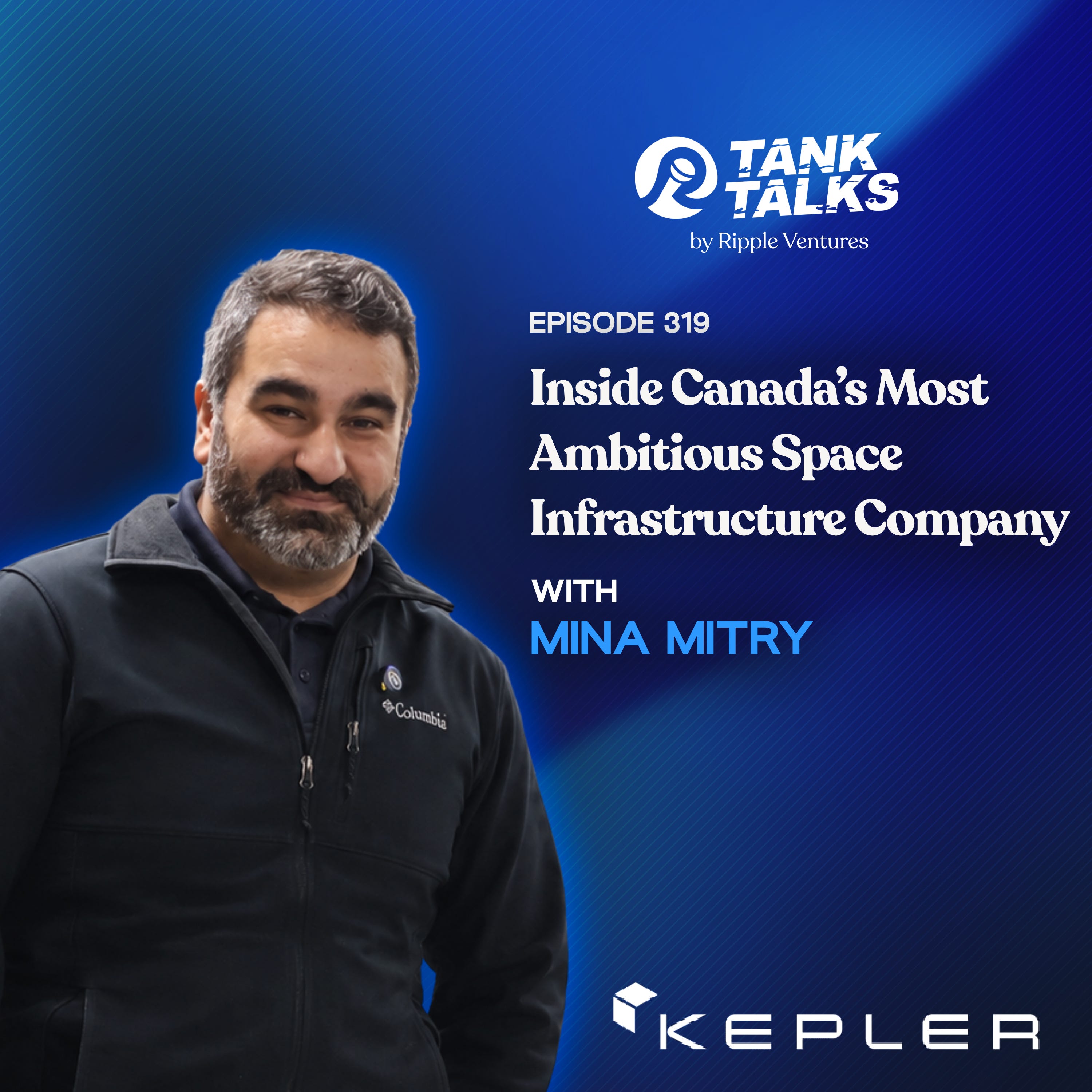
In this episode of Tank Talks, host Matt Cohen sits down with Mina Mitry, CEO and Co-Founder of Kepler Communications, one of the world’s most ambitious space infrastructure companies. With a journey that spans from winning $75,000 in university pitch competitions to building the world’s first commercial optical data relay network, Mina’s experience offers valuable insights for founders, especially those navigating the challenges of building deep-tech and hardware-driven companies.
Mina shares his entrepreneurial beginnings, the lessons he learned while scaling Kepler, and the hard pivot from off-the-shelf software to a vertically integrated satellite manufacturing model. He also discusses the Arctic surveillance gap, why real-time space data is critical for Canadian sovereignty, and how Kepler was selected as prime contractor for ESA’s Hydron Element 3 project.
From launching 10 satellites on a SpaceX Falcon 9 to shooting lasers across 6,500 kilometers in orbit, Mina dives into his journey and the key principles he follows in his entrepreneurial endeavors. Whether you’re interested in space tech, defense, or sovereign infrastructure, Mina’s story provides inspiration and practical wisdom.
From University Rockets to Building Space Infrastructure (02:03)
Mina’s journey from a first-generation immigrant family to co-founding Kepler at the University of Toronto
Why Kepler’s original mission of bringing the internet beyond Earth has never changed
The ultimatum that convinced his co-founders to leave traditional career paths behind
The Early Days of Kepler and Finding Product-Market Fit (06:36)
How Kepler survived the early years with limited capital and massive ambition
Why remote communications in the Arctic became one of the company’s first real-world use cases
The challenge of convincing investors in 2015 that orbital laser networks were even possible
Satellites, Orbital Networks, and Why Space Connectivity Matters (08:25)
A breakdown of low Earth orbit, geostationary orbit, and why northern connectivity remains difficult
How Kepler built the world’s first commercial laser-based relay network in space
Why real-time data transmission is becoming critical for everything from disaster response to defense
Building Canada’s Largest Orbital Data Center (14:22)
What it actually means to put compute infrastructure in orbit
Why SpaceX, Starship, and falling launch costs could completely reshape the space economy
The engineering, thermal, and regulatory challenges of scaling orbital infrastructure
Inside Kepler’s Falcon 9 Launch Moment (16:48)
What it felt like watching Kepler’s satellites launch from Vandenberg for the first time
The emotional significance of one of Canada’s largest space milestones in years
Why launch economics and insurance remain misunderstood parts of the industry
Defense, Arctic Surveillance, and Sovereign Space Infrastructure (19:42)
How Kepler is helping governments access real-time intelligence from space
Why the Arctic has become a major strategic priority for Canada and its allies
The role of orbital infrastructure in missile detection, surveillance, and national security
The Geopolitical Tailwinds Behind Space Sovereignty (23:19)
Why middle powers are increasingly investing in sovereign technology infrastructure
How defense ministries around the world are approaching space-based intelligence differently
The recurring revenue model behind Kepler’s government partnerships
Why Space Tech Moats Are Built Over Decades (26:56)
Why Mina believes infrastructure, regulatory access, and time are harder to replicate than capital
The importance of spectrum rights, security clearances, and orbital heritage
Why Kepler’s biggest competitive advantage may simply be the years it has already spent building
Jeremy Hansen, Artemis II, and Inspiring the Next Generation (28:43)
What Canada’s moon mission means for the future of the country’s space sector
Why Mina believes visibility and inspiration matter as much as technology itself
How astronauts have become both cultural icons and catalysts for innovation
Why Ambition Still Matters Most for Founders (31:00)
Mina’s advice for founders building difficult, long-term companies
Why independent thinking matters more than following trends
The types of space startups Mina believes are still too early to realistically succeed
About Mina Mitry
Mina Mitry is the CEO and co-founder of Kepler Communications, a Toronto-based space infrastructure company building the world’s first commercial optical data relay network. A first-generation Egyptian-Canadian, Mina started Kepler out of the University of Toronto in 2015 with $75,000 from pitch competitions. Under his leadership, Kepler has grown to over 200 employees, vertically integrated its satellite manufacturing, and launched 10 optical relay satellites on a SpaceX Falcon 9 in January 2026. Mina holds advanced degrees in engineering, left a PhD program to start Kepler, and has become one of Canada’s most outspoken advocates for sovereign space capability, real-time data infrastructure, and ambitious engineering.
Connect with Mina Mitry on LinkedIn: https://www.linkedin.com/in/mmitry?originalSubdomain=ca
Visit Kepler Communications website: https://kepler.space/
Connect with Matt Cohen on LinkedIn: https://ca.linkedin.com/in/matt-cohen1
Visit the Ripple Ventures website: https://www.rippleventures.com/


